ICM stands for the Institute for Conservation Medicine, which was established in 2011 by the Saint Louis Zoo in order to address the rapidly growing diseases that are affecting long-term survival of many species as well as human health. Research is focused on endangered species and the diseases that impact those species. The Saint Louis Zoo partners with institutions all over the world including Turtle Survival Alliance, Wildlife Conservation Society, Zoo Atlanta, Mississippi Aquarium, and Zoo Knoxville to focus on conservation with all sorts of animals around the whole planet. Emphasis is placed on health challenges, domestic and wild animals, as well as human health.
ICM offers many internships as well for those interested in the field, whether it be research based, medical, or tracking animals, ICM truly offers a place for everyone.
One of the labs in Madagascar used to help monitor the health of the tortoises, Saint Louis Zoo Institute for Conservation Medicine
Saint Louis Zoo Institute for Conservation Medicine. Saint Louis Zoo. (n.d.). https://stlzoo.org/conservation/saint-louis-zoo-institute-for-conservation-medicine
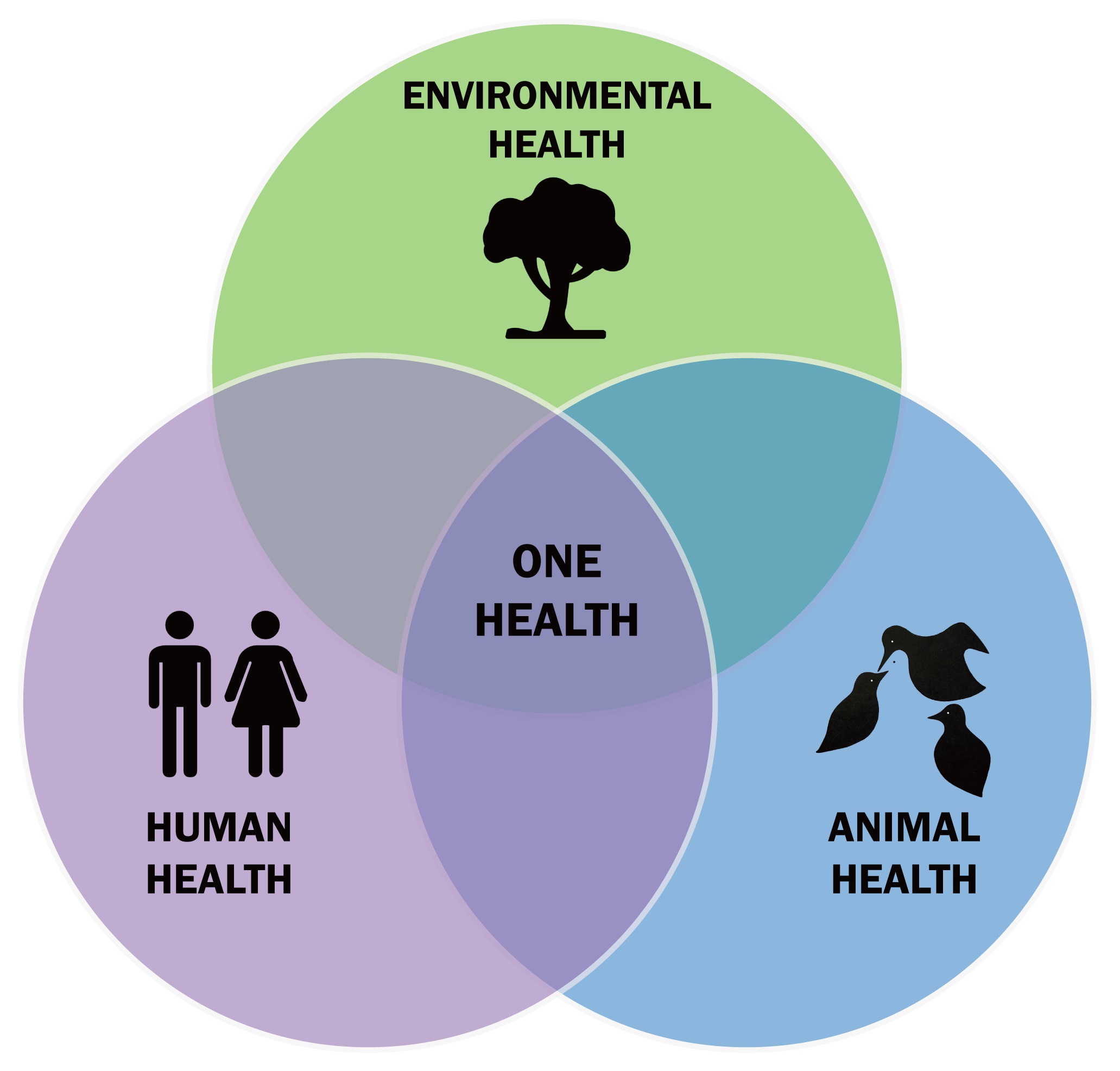
One Health is not a specific thing, but rather an approach that recognizes the interconnectedness of the health of humans, animals, and the environment. While it’s not a new concept, One Health has become more influential in recent years due to new factors impacting interactions between humans, animals, and the environment. Between growing human populations, movement of humans and animals, as well as climate change, interactions among humans, animals, and the environment are rapidly changing.
Centers for Disease Control and Prevention. (2024, October 30). About one health. Centers for Disease Control and Prevention. https://www.cdc.gov/one-health/about/index.html
One Health Triad. (2020). Environmental Investigation Agency. photograph. Retrieved June 19, 2025, from https://eia-international.org/wp-content/uploads/One-Health-Triad-en.jpg.
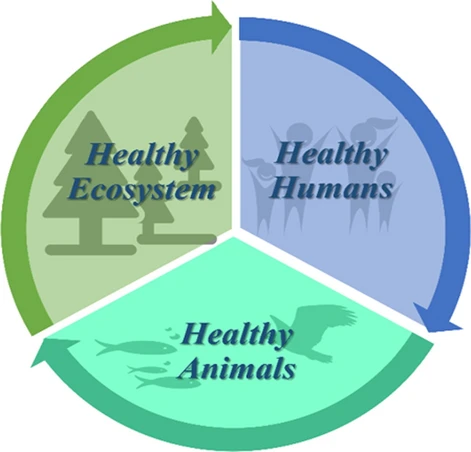
Traversed dynamics of climate change and One Health. (2025). photograph.
The images of the One Health Triad is designed to show the interconnectedness of humans, animals, and the ecosystem. The visual helps further just how vital the three aspects are and how important they are to one another. While the concept of One Health is fairly new, the ideas that create it have been around forever.
The Association of Zoos and Aquariums (AZA) reports that, “Despite only being close in size to the state of Texas, Madagascar supports nearly 5% of all the plant and animal species on earth; nevertheless, most of this exceptional wildlife is threatened with extinction. The Radiated Tortoise (Astrochelys radiata) is just one of the island’s many endemic species, which has disappeared from more than half of its historic range and scientists predict that we could lose this species forever if far-reaching and immediate conservation action is not taken soon.” It is abundantly clear the Madagascar’s animal populations are struggling due to major issues like poaching. Madagascar is a unique place, as an island with so many endemic species it is becomingly increasingly more clear the importance of protecting the wildlife of Madagascar.
Dr. Tsanta recognizes the uniqueness of working in Madagascar with the local customs, saying that,
“Customs and taboos are often beneficial for us, like touching the tortoises for the Atandroy tribe, but can be very challenging too as they refuse to work sometimes because of the taboos. For example, it’s good that they don’t touch tortoises, so they won’t pick them up in the wild for the illegal trafficking. But sometimes they use that taboo to avoid taking care of the confiscated when needed.”
Radiated tortoise overlooking cliff at Cap Sainte Marie Special Reserve in southern Madagascar.
Sources:
Saint Louis Zoo Institute for Conservation Medicine
Naturally occurring only in the southern and southwestern regions of Madagascar, the radiated tortoise (Astrochelys radiata) gets its name from the star pattern on its shell, with yellow lines that radiate from the center of each dark plate. They can grow to a shell length of 16in (40cm) and 35lb (16kg) though some grow to be even bigger than that. They are herbivores, eating mostly grasses, fruit, and succulent plants. They are active during the day, the most active during the hours of 6:30-10 am and then again from 3:30-6 pm. They are much more active during the summer when the temperature is comfortable for them, typically around 82-91 degrees Fahrenheit. They spend most of the day grazing, which makes up about 80-90% of their diet. The average lifespan is around 40-50 years however, the oldest recorded radiated tortoise lived to 188! While they used to be one of the most abundant tortoises, they are now considered Critically Endangered by the IUCN Red List. Their population is greatly decreasing due to habitat loss as well as illegal poaching for domestic and international food/pet markets leaving them categorized as Critically Endangered by the International Union for Conservation of Nature (IUCN) and Endangered by the U.S. Endangered Species Act.
Dr. Tsanta loves working with the tortoises but notes that it is not always the easiest job. Keeping them in the enclosures is a long term project, keeping them until they are healthy and big enough to survive on their own in the wild. Furthermore, tortoises do not show signs of illness until they are essentially dying, which makes caring for them difficult. They are solitary animals that only need another tortoises during mating season.
Image: A baby radiated tortoise being held in Madagascar, Saint Louis Zoo Institute for Conservation Medicine
Sources:
Radiated tortoise. Turtle Survival Alliance. (2025, January 24). https://turtlesurvival.org/species/radiated-tortoise/?srsltid=AfmBOorQ79uFINfCS53R6A9RbqS8Wv4XP237ll9TxFW1lfJVSMlTaYdC
Radiated tortoise. Smithsonian’s National Zoo and Conservation Biology Institute. (2016, April 25). https://nationalzoo.si.edu/animals/radiated-tortoise
SAFE Saving Animals From Extinction . Safe species. (2017). https://www.aza.org/safe-species#radiatedtortoise
Interview: Dr. Tsanta Fiderana Rakotonanahary, expert working with the tortoises in Madagascar
While the radiated tortoise used to be abundant, the radiated tortoise is now categorized as Critically Endangered by the International Union for Conservation of Nature (IUCN) and Endangered by the U.S. Endangered Species Act. In order to remedy this, a program was launched to study the radiated tortoise in Madagascar, as that is the only place they live in the wild. Poaching is a major issues, for both the food and pet trade, domestically and internationally.
SAFE Saving Animals From Extinction . Safe species. (2017). https://www.aza.org/safe-species#radiatedtortoise
Radiated tortoise project. Saint Louis Zoo. (n.d.-a). https://stlzoo.org/radiated-tortoise-project
Saint Louis Zoo Institute for Conservation Medicine
A radiated tortoise enclosure at the care center in Madagascar
The AZA radiated tortoise SAFE (Saving Animals From Extinction) program began in 2017 with the goal in mind of protecting the tortoises. This has been done in all sorts of ways including increased education and public awareness, increasing funding for the SAFE project, build up the capacity of law enforcement to protect the tortoises, as well as other actions since the project started. The Saint Louis Zoo Institute for Conservation Medicine has been working in Madagascar since January 2020.
The tortoises are confiscated from illegal capture and holding and returned to southern Madagascar. They get health checks and are placed in enclosures for continued care. They are sorted by size in order to have a fair chance to get food. Once big enough, the tortoises are released into the wild. Out of 1,000 tortoises about 45 are tagged. These tortoises are tracked every 15 days for the first 2 years after release. For the first 3-6 months, the tortoises are placed in a large pen. The tortoises have the option to leave the pen whenever they like but typically after 3 months, the pen is removed. The tortoises are studied for their movements and eating habits in different temperatures. There is always more to learn and this drive is helping keep the tortoise populations alive.
Image: Bonnie Raphael, Jamie Palmer, and TSA staff performing radiated tortoise health check in Madagascar, Saint Louis Zoo Institute for Conservation Medicine
Sources:
Aza radiated tortoise safe – assets service. SAFE Saving Animals From Extinction. (2023, October 2). https://assets.speakcdn.com/assets/2332/sf2023-2025radtfpp.pdf
Madagascar. Turtle Survival Alliance. (2025a, April 11). https://turtlesurvival.org/programs/madagascar/
Radiated tortoise project. Saint Louis Zoo. (n.d.). https://stlzoo.org/radiated-tortoise-project
Interview: Dr. Tsanta Fiderana Rakotonanahary, expert working with the tortoises in Madagascar
Overall, the goal is to rebuild the wild population of the radiated tortoises. Census of wild tortoise populations help keep track of what the wild population numbers look like. Regular health checks are done on the tortoises to prevent the spreading of diseases and keep the wild population numbers up. Genetics and movement of the tortoises are studied as well.
Several grants are necessary in order to take care of the tortoises when they are in the enclosures and thus, various institutions are working hard to achieve this goal. Institutions like the Turtle Survival Alliance and various zoos all over the United States are part of this project. In the next four years, the plan is to release 20,000 tortoises back into the wild.
Dr. Tsanta loves working with the tortoises, noting that she is constantly learning new things. She also spends time traveling and meeting new people, leading toward new experiences and new cultures. She wishes that people knew just how difficult it is to work with the tortoises and wants to expand the labs in Madagascar as they have limited capabilities. She, along with many others across the globe hope to see the populations increase.
Dr. Tsanta Fiderana Rakotonanahary, expert working with the tortoises in Madagascar
Saint Louis Zoo Institute for Conservation Medicine
The photo above shows the lab in Madagascar, used to help monitor the health of the tortoises.
My name is Addison Gutschenritter, and I had the privilege of being an intern with ICM at the Saint Louis Zoo. I am a recent graduate of Pattonville High School and am off to college at American University in the fall. Through this project I had the wonderful opportunities to speak with Dr. Tsanta, an expert in the field, as well as meet Bob the radiated tortoise who is held in captivity at Animal Kingdom Lodge in Orlando, FL.
Addison Gutschenritter, photo by Lara Corvera
Dr. Tsanta Fiderana Rakotonanahary and
Dr. Tsanta Fiderana Rakotonanahary and Jamie Palmer
Bob the radiated tortoise, photos by Addison Gutschenritter